The rapid development of generative AI is making it increasingly difficult to reliably distinguish AI interactions and AI-generated content from human content. This can result in people being confronted with misinformation, or even being deliberately manipulated or deceived. To counteract this, Art 50 AI Act provides for transparency obligations for certain AI systems. Just under two weeks before its entry into force on 2 August 2026, the European Commission published its transparency guidelines (available here, the "Guidelines"). They are intended to provide AI actors and authorities with practical assistance in implementing the relevant obligations. Below, we summarise the key points as well as selected best practices:
Transparency Obligations in detail
The Guidelines specify the scope of application of the labelling obligations by listing exemptions and practical examples. By contrast, they contain only limited information on specific technical implementation. The European Commission’s voluntary Code of Practice (available here; the "Code of Practice") provides better guidance in this respect. Both documents are an important aid to interpretation for practical implementation. Compliance with the Code of Practice even gives rise to a presumption of conformity.
The labelling must be provided no later than at the time of the first interaction in a clear, easily perceptible and understandable form – including for people with disabilities (Art 50(5) AI Act). The accessibility requirements (e.g. the BaFG, ETSI EN 301 549 or the W3C Web Content Accessibility Guidelines) must therefore also be taken into account. This includes, for example, sufficient contrast, good readability and technical support through screen readers or alternative text descriptions.
On the individual transparency obligations:
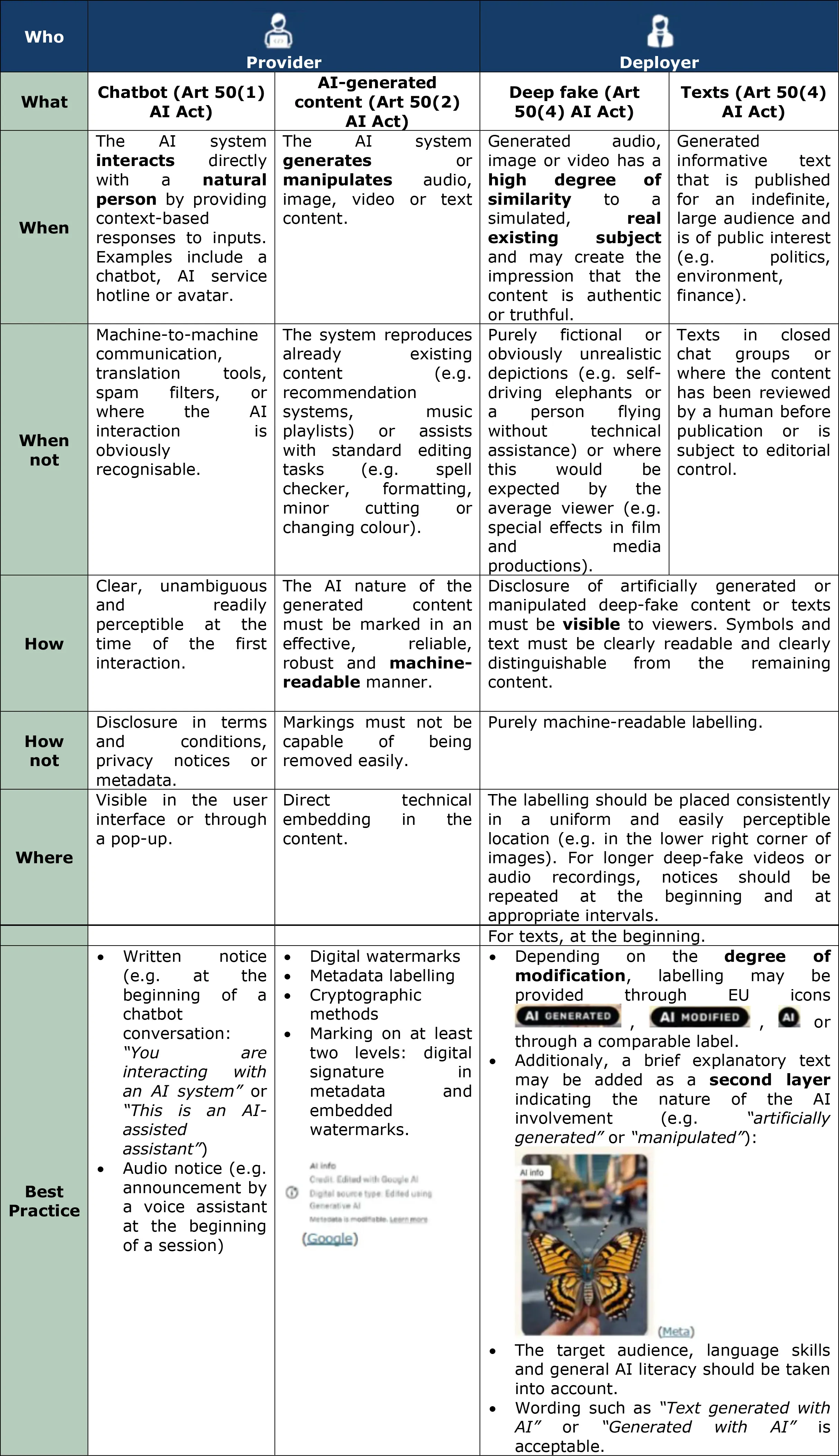
Documentation and Accountability Obligations
Actors can demonstrate compliance with the transparency obligations for AI-generated content (Art 50(2)), deepfakes and texts (Art 50(4)) by complying with a Code of Practice that has been assessed as appropriate (Art 50(7) AI Act). This applies to the Code of Practice published by the European Commission (see here). Alternatively, providers and deployers may demonstrate compliance with their obligations through other suitable measures. Following the Code of Practice is likely to be the simpler and legally more certain way of fulfilling the transparency obligations.
There is no comparable presumption of conformity for the labelling of human-machine interaction (Art 50(1)) or for emotion recognition systems and biometric categorisation systems (Art 50(3)). The affected actors must therefore define suitable disclosure and labelling measures themselves. The Guidelines and the Code of Practice may be used as guidance in this respect.
Beyond the labelling obligations, the European Commission clarifies that deployers of AI systems must also implement appropriate competence, awareness-raising and review measures in order to properly comply with Art 50 AI Act (Code of Practice, 34). These include, for example, training, policies and internal processes to ensure correct labelling and editorial control.
Outlook
The transparency obligations under Art 50 AI Act generally apply from 2 August 2026. Under the AI Omnibus, however, an extended transitional period until 2 December 2026 applies to the machine-readable labelling of AI-generated output if the AI system was already placed on the market before 2 August. For new AI systems and the remaining transparency obligations, the original applicability date remains unchanged. Infringements of the transparency obligations may be punishable by fines of up to EUR 15 million or 3% of worldwide annual turnover, whichever is higher (Art 99(4) AI Act).
Enforcement is carried out by the competent national market surveillance authorities. In Austria, national accompanying legislation to the AI Act and the designation of authorities are still pending. Based on the current status, no national administrative penalties will therefore be imposed as of 2 August 2026. However, this does not mean that an infringement of the AI Act cannot have consequences. For example, civil law claims are conceivable in the event of a violation of personality rights or damage. In addition, there may be a possible competition law infringement where a competitive advantage is gained through breach of law under § 1 UWG, or misleading conduct due to the absence of labelling under § 2 UWG. Depending on the circumstances, the data protection transparency principle may also be infringed. Companies therefore already need to take action.
We will keep you informed of further developments.